
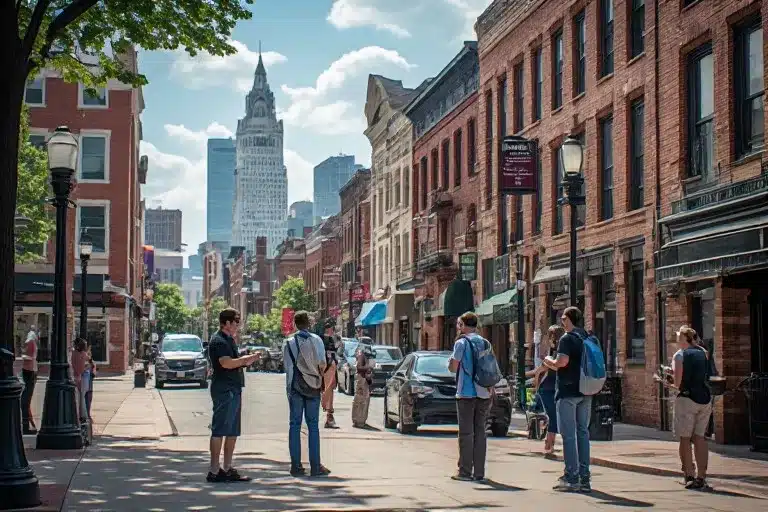
Nashville’s streets are more than routes between attractions. Some follow corridors that have carried residents, merchants, travelers, politicians, musicians, and visitors through generations of the city’s development. Their names, buildings, intersections, and changing uses preserve clues about how Nashville grew from a Cumberland River settlement into modern Music City.
A Nashville history tour can make these ordinary-looking streets much more meaningful. Broadway, Second Avenue, Church Street, Charlotte Avenue, and other historic corridors have changed dramatically, but traces of earlier Nashville remain visible to visitors who know where to look.
Why Nashville’s Historic Streets Matter
A city’s street network can function like a historical record.
Roads influence where people live, where businesses develop, how goods move, and which parts of a city become commercial or cultural centers. As Nashville expanded, its streets connected the riverfront with government buildings, neighborhoods, transportation hubs, businesses, churches, and entertainment districts.
Street History Reveals How Nashville Changed
The purpose of a street can change substantially over time.
A corridor once dominated by warehouses may become an entertainment district. A commercial street can become associated with hotels and offices. Residential areas can evolve into business districts.
Understanding those changes helps visitors see modern Nashville as one chapter in a much longer urban story.
Broadway Is Older Than Its Modern Entertainment Identity
Today, Broadway is internationally associated with Nashville nightlife.
Visitors know Lower Broadway for honky-tonks, live music, neon signs, restaurants, rooftop venues, and crowds. Yet the street’s history extends far beyond its current entertainment identity.
Its location near the Cumberland River placed it within Nashville’s historic commercial core.
Lower Broadway Was a Commercial District
Before tourism and live entertainment became dominant, downtown Nashville depended heavily on commerce.
Businesses serving residents, travelers, agricultural interests, and regional trade operated throughout the area.
Many older commercial buildings along Broadway reflect this earlier chapter.
Looking above modern storefronts and signs can reveal architectural details that help visitors recognize the age and original character of the buildings.
Broadway Connects the Riverfront With the City’s Interior
Broadway’s physical relationship with the Cumberland River is important to understanding its development.
Nashville grew around transportation and commerce, and the river played a major role in connecting the city with regional markets.
Roads extending from the riverfront helped move people and goods between the waterfront and the expanding city.
Geography Explains the Street’s Importance
Historic streets make more sense when visitors consider geography.
Ask where the street begins, what major destinations it connects, and how it relates to the river, railroads, government buildings, or former commercial districts.
These relationships often explain why certain corridors became important.
Second Avenue Preserves Nashville’s Commercial Past
Second Avenue is another important downtown corridor for understanding Nashville’s earlier commercial development.
Historic buildings along the street reflect the period when warehouses, wholesalers, merchants, and other businesses operated near the Cumberland River.
The architecture helps visitors imagine a downtown economy that looked very different from today’s tourism-focused environment.
Historic Warehouses Tell a Business Story
Warehouse and commercial architecture may appear less glamorous than major civic landmarks, but these buildings are essential to understanding how a city functioned.
Merchants needed places to store, sell, and distribute goods.
The concentration of commercial buildings near transportation routes demonstrates how closely Nashville’s growth was connected with trade.
Second Avenue Has Experienced Major Change
Like many parts of Downtown Nashville, Second Avenue has experienced redevelopment, changing businesses, preservation efforts, and major disruptions.
The corridor demonstrates how historic streets continue evolving rather than remaining frozen in one era.
Preservation Helps Retain the Historic Streetscape
Individual buildings matter, but groups of historic buildings can be even more significant.
When several older structures survive together, visitors can better understand the scale and appearance of an earlier commercial district.
Preserving a streetscape can therefore maintain historical context that would be lost if only isolated buildings remained.
Church Street Reflects Nashville’s Changing Downtown
Church Street has long been part of Nashville’s downtown street network.
Its history intersects with commerce, transportation, religious institutions, hotels, entertainment, and urban development.
Today, the street passes through a modern downtown environment, but surviving historic buildings and older institutions provide connections with earlier periods.
Street Names Can Preserve Historical Clues
Street names often become so familiar that residents stop considering where they came from.
Names may refer to geographic features, institutions, prominent individuals, early landowners, or former uses.
Researching the origins and changes of Nashville street names can reveal details that are not immediately visible in the modern streetscape.
Printer’s Alley Reveals a Different Side of Downtown
Printer’s Alley is much smaller than Broadway or Church Street, but its historical importance demonstrates that size does not determine significance.
The alley became associated with Nashville’s printing and publishing industries.
Later, it developed a strong connection with nightlife and entertainment.
One Street Can Have Several Identities
Printer’s Alley illustrates how urban places acquire new identities over time.
A location connected with one industry can later become known for something completely different.
Understanding those layers makes historic sightseeing more interesting because visitors begin to recognize that today’s Nashville occupies the same spaces used by earlier generations for very different purposes.
Charlotte Avenue Connects Downtown With Nashville’s Expansion
Charlotte Avenue provides another example of how major roads helped connect central Nashville with developing areas farther from the original urban core.
As Nashville expanded, transportation corridors became essential for connecting neighborhoods, businesses, institutions, and surrounding communities.
Historic Roads Help Explain Urban Growth
Cities generally expand along transportation routes.
Roads influence where commercial districts emerge and where residential development becomes practical.
Studying a corridor such as Charlotte Avenue can therefore help visitors understand Nashville not simply as a collection of neighborhoods but as an interconnected urban system.
Jefferson Street Tells an Essential Nashville Story
Jefferson Street is one of the most important corridors for understanding Nashville’s African American history.
The surrounding community became a center of Black business, education, religious life, entertainment, and culture.
Its history is closely associated with institutions including Fisk University, Meharry Medical College, and Tennessee State University.
Jefferson Street Had a Major Music Scene
Nashville’s musical identity was never limited to Lower Broadway or country music.
Jefferson Street became known for a vibrant entertainment scene where Black musicians and audiences participated in blues, jazz, rhythm and blues, and other musical traditions.
This history adds an essential dimension to Nashville’s Music City identity.
Interstate Construction Changed the Jefferson Street Community
Twentieth-century highway development dramatically affected portions of North Nashville.
The construction of Interstate 40 disrupted established communities near Jefferson Street, affecting homes, businesses, and neighborhood connections.
Understanding this history changes how visitors interpret the modern corridor.
Roads Can Connect and Divide
Transportation infrastructure is usually built to improve mobility, but its effects are not always equally distributed.
A new road can improve regional access while simultaneously disrupting an established neighborhood.
Nashville’s transportation history therefore includes both growth and displacement.
Music Row’s Streets Reveal Nashville’s Recording History
Music Row offers another type of historic streetscape.
The district is closely associated with recording studios, music publishers, record labels, management companies, and other businesses that helped establish Nashville as an international music center.
Yet parts of Music Row still reveal the area’s earlier residential character.
Houses Became Music Businesses
One of the distinctive features of Music Row is the adaptation of former residential properties for commercial music-industry use.
This creates a streetscape where the architecture does not always reveal the significance of what happened inside.
Without context, a visitor might pass a modest building without realizing its connection to recording, songwriting, publishing, or music-business history.
Demonbreun Street Reflects Nashville’s Modern Transformation
Demonbreun Street connects areas associated with downtown, entertainment, tourism, and newer development.
Its modern appearance demonstrates how rapidly parts of Nashville have changed.
The street also provides an opportunity to discuss how development pressures reshape historic urban environments.
Old Nashville and New Nashville Often Share the Same Block
One of the defining characteristics of modern Nashville is the proximity of old and new development.
Historic buildings can stand beside hotels, residential towers, offices, and entertainment venues constructed generations later.
This contrast makes the city particularly useful for studying how urban landscapes evolve.
Historic Street Names Can Change
Street names are not necessarily permanent.
Cities sometimes rename streets because of redevelopment, political decisions, commemorations, changes in transportation, or attempts to simplify navigation.
Older maps may therefore use names unfamiliar to modern visitors.
Historic Maps Reveal Earlier Nashville
Comparing current maps with nineteenth- and twentieth-century maps can reveal:
- Streets that were renamed
- Roads that disappeared
- Changes to intersections
- Former railroad corridors
- Earlier neighborhoods
- Historic commercial districts
- Changes along the riverfront
- Areas affected by highway construction
- Former industrial properties
- Buildings that no longer exist
These comparisons can make Nashville’s urban transformation much easier to visualize.
Alleys Are Part of Nashville’s History Too
Major streets naturally attract attention, but alleys can provide equally useful historical clues.
They supported deliveries, service access, businesses, utilities, and movement behind major commercial buildings.
Some later developed cultural identities of their own.
Look Behind the Main Facades
The front of a historic building was designed for customers and public visibility.
The rear may reveal a different story.
Loading areas, older brickwork, secondary entrances, architectural modifications, and service corridors can provide clues about how commercial buildings functioned.
Visitors should explore only publicly accessible areas and respect private property.
The Cumberland River Shaped Nashville’s Street Network
The Cumberland River was fundamental to Nashville’s early development.
Before automobiles and interstate highways dominated transportation, river access was crucial for trade and movement.
The relationship between downtown streets and the river therefore helps explain the location of Nashville’s historic commercial core.
Walk Toward the River to Understand Downtown
When exploring downtown, notice how streets approach the Cumberland River.
Imagine the city before modern towers, arenas, highways, and large entertainment venues changed the landscape.
Thinking geographically can help transform seemingly ordinary streets into evidence of Nashville’s earlier economy.
The Civil War Changed Nashville’s Streets
Nashville’s streets also witnessed major events during the Civil War.
Union occupation beginning in 1862 transformed the city into an important military and logistical center.
Troops, supplies, hospitals, fortifications, military offices, refugees, civilians, and laborers became part of the wartime landscape.
Imagine Nashville Without Modern Traffic
It can be difficult to visualize nineteenth-century events while standing beside modern vehicles and buildings.
Try mentally removing contemporary development.
Think about dirt or differently surfaced roads, horse-drawn transportation, military movement, crowded wartime facilities, and the much smaller physical scale of the city.
Historical interpretation can help reconstruct this lost landscape.
Nashville’s Streets Witnessed the Civil Rights Movement
Downtown Nashville became an important setting for civil rights activism during the twentieth century.
Students challenged segregation through organized nonviolent demonstrations, including sit-ins at downtown lunch counters.
Streets connecting universities, churches, businesses, and government institutions became part of this larger movement.
Public Space Can Become Historical Space
Major historical events do not always happen inside monuments or government buildings.
Sidewalks, stores, streets, and ordinary commercial spaces can become historically significant because of the people who acted there.
This is one reason walking through Nashville with historical context can be so valuable.
Architecture Along Historic Streets Provides Clues
When exploring an older Nashville street, avoid focusing only on businesses currently occupying the buildings.
Look above the ground floor.
Upper stories frequently preserve architectural details that modern storefront renovations have hidden below.
What to Look For
Pay attention to:
- Brick patterns
- Window shapes
- Cornices
- Stonework
- Building dates
- Arches
- Decorative details
- Former entrances
- Rooflines
- Differences in building height
- Historic signs
- Evidence of renovations
These details can help identify different periods of construction and development.
Why Some Historic Streets Look Completely Different Today
Urban landscapes change because cities must adapt to new populations, technologies, economies, and transportation systems.
Nashville has experienced fires, floods, wars, redevelopment, highway construction, demolition, preservation, and rapid modern growth.
As a result, some historic streets retain substantial older architecture while others have changed almost completely.
Absence Can Be Historically Important
Sometimes the most important thing about a location is what no longer exists there.
A parking facility, highway, modern tower, or empty space may occupy land that once contained homes, businesses, churches, or community institutions.
Historical maps and photographs can help recover these lost urban landscapes.
How to Explore Nashville’s Historic Streets
Historic street exploration works particularly well when visitors combine observation with research.
Instead of rushing between famous attractions, choose a smaller area and examine it carefully.
Look at buildings, street patterns, public markers, alleys, architectural details, and the relationship between old and new development.
Walk Some Areas and Drive Others
Downtown corridors such as Broadway, Second Avenue, and Church Street can be examined closely on foot.
Other historic areas are spread farther apart and may be easier to understand through a vehicle-based sightseeing experience.
Combining walking and driving allows visitors to see both individual architectural details and Nashville’s broader geography.
Use a Nashville History Tour for Context
Many historic streets do not clearly advertise their history.
Without interpretation, visitors may see restaurants, offices, hotels, entertainment venues, and traffic without realizing what occupied those locations generations earlier.
A Nashville history tour can connect the modern streetscape with those earlier stories.
Ask What Was Here Before
One of the most useful questions during historical sightseeing is simple: What was here before?
That question can reveal former businesses, neighborhoods, transportation systems, music venues, homes, industries, and institutions that have disappeared.
It also encourages visitors to see Nashville as a city built in layers.
Frequently Asked Questions
What are some historic streets to explore in Nashville?
Broadway, Second Avenue, Church Street, Jefferson Street, and streets around Music Row are among the corridors that can help visitors understand different aspects of Nashville’s commercial, cultural, African American, and music history.
Why is Broadway historically important?
Broadway’s history predates its modern entertainment identity. Its location near the Cumberland River placed it within Nashville’s historic commercial core, and older buildings along the corridor preserve evidence of earlier downtown commerce.
Why is Jefferson Street important to Nashville history?
Jefferson Street became an important center of African American business, education, religion, culture, and music. The surrounding community was also significantly affected by twentieth-century interstate construction.
Is Printer’s Alley actually historic?
Yes. Printer’s Alley is associated with Nashville’s printing and publishing history and later became known for nightlife and entertainment, giving the area several layers of historical identity.
Can visitors walk Nashville’s historic streets?
Many historic downtown corridors can be explored on foot. Conditions, distances, traffic, accessibility, and weather should be considered when planning a route.
Why should I take a Nashville history tour instead of exploring alone?
Independent exploration provides flexibility, while a guided experience can explain buildings, former neighborhoods, street-name changes, historical events, and locations whose significance may not be obvious from the modern streetscape.
Nashville’s oldest streets reveal how dramatically Music City has evolved. Commercial corridors became entertainment districts, residential areas became music-industry centers, transportation projects reshaped neighborhoods, and ordinary downtown streets became settings for nationally significant historical events.
Exploring these corridors as part of a Nashville history tour can make the modern city easier to understand. Instead of seeing only what stands along a street today, visitors can begin to recognize the generations of commerce, music, community life, conflict, activism, and development beneath Nashville’s modern streetscape.