
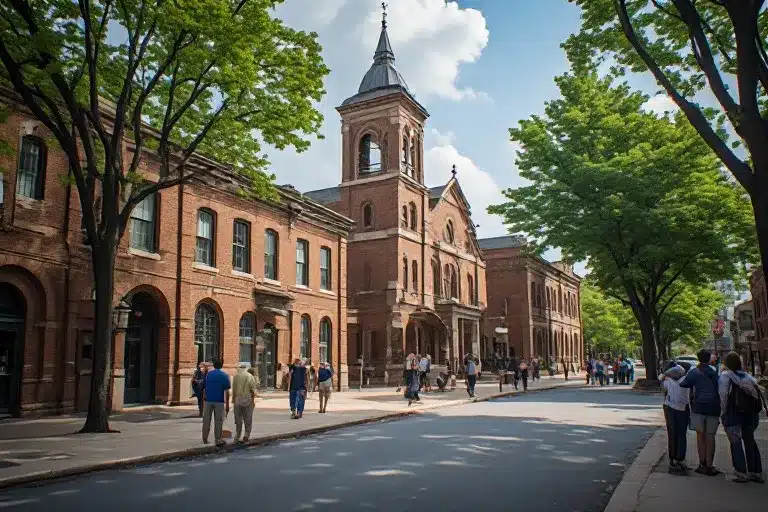
Nashville’s historic churches provide a window into the city’s architecture, faith communities, social movements, and cultural development. Long before Music City became internationally known for entertainment and tourism, churches served as gathering places where generations of Nashvillians worshiped, organized, learned, and built communities.
Adding historic churches to a Nashville history tour can reveal stories that extend far beyond the buildings themselves. From unusual nineteenth-century architecture to sites associated with African American history and the civil rights movement, these churches help visitors understand how faith and community influenced Nashville’s development.
Why Nashville’s Historic Churches Are Worth Exploring
Historic churches preserve multiple layers of Nashville’s past.
Their architecture can reveal the design preferences of an era, while the congregations associated with them can tell stories about migration, race, education, politics, community organization, and social change.
Some congregations have histories that are considerably older than the buildings they currently occupy.
More Than Historic Architecture
Columns, towers, stained glass, arches, masonry, and decorative details make historic churches visually interesting, but architecture tells only part of their story.
Visitors should also consider who founded each congregation, who worshiped there, how the surrounding neighborhood developed, and what events occurred within the building.
These human connections transform architectural landmarks into meaningful historical sites.
Downtown Presbyterian Church
Downtown Presbyterian Church is one of Nashville’s most distinctive historic religious buildings.
Its Egyptian Revival design immediately separates it from the Gothic and Classical architectural traditions commonly associated with historic American churches.
The building was designed by William Strickland, the architect responsible for the Tennessee State Capitol.
An Unusual Egyptian Revival Design
Egyptian Revival architecture incorporates design elements inspired by ancient Egyptian forms.
Visitors can look for distinctive columns, decorative motifs, proportions, and architectural details that give the church its unusual appearance.
Seeing the building alongside other Strickland-designed Nashville landmarks can also provide insight into the city’s nineteenth-century architectural development.
A Connection to the Tennessee State Capitol
William Strickland’s connection with both Downtown Presbyterian Church and the Tennessee State Capitol provides an interesting link between Nashville’s religious and civic architecture.
Exploring the two buildings allows visitors to compare very different structures created by the same architect.
This type of architectural connection is easy to overlook without historical context.
Christ Church Cathedral
Christ Church Cathedral provides another important example of historic religious architecture in Downtown Nashville.
Its Gothic Revival character creates a strong contrast with Nashville’s modern commercial buildings and high-rise development.
Stone construction, pointed arches, windows, and other architectural features contribute to the building’s distinctive appearance.
Historic Architecture in a Changing Downtown
One reason Christ Church Cathedral is particularly interesting is its relationship with the modern city surrounding it.
Nashville has experienced substantial downtown development, yet historic structures continue to occupy portions of the urban landscape.
Looking at the cathedral alongside neighboring buildings provides a visual demonstration of how different periods of Nashville’s development coexist.
St. Mary’s Catholic Church
St. Mary’s Catholic Church is another important historic religious site near Nashville’s governmental center.
Its history contributes to the broader story of Catholicism and religious diversity in nineteenth-century Nashville.
Its proximity to the Tennessee State Capitol also makes the church a useful addition to a historical walking route through this part of downtown.
Nashville’s Religious History Was Diverse
Nashville’s historical population was never represented by a single religious tradition.
Different denominations and communities established churches and institutions throughout the city.
Exploring several historic churches can therefore provide a more complete understanding of the religious and cultural groups that contributed to Nashville’s development.
First Baptist Church Capitol Hill
First Baptist Church Capitol Hill has deep connections with Nashville’s African American religious history.
The congregation’s roots extend into the nineteenth century and the development of independent Black religious institutions following slavery.
Historically Black churches became important centers of worship, education, community leadership, mutual assistance, and social organization.
Black Churches After Emancipation
The end of slavery created opportunities for African Americans to build independent institutions while confronting discrimination, segregation, violence, and political restrictions.
Churches became some of the most important institutions within newly developing Black communities.
Understanding their role provides important context for Nashville’s history after the Civil War.
Clark Memorial United Methodist Church
Clark Memorial United Methodist Church holds particular significance in Nashville’s civil rights history.
The church is associated with the organization and nonviolent training that helped prepare participants in Nashville’s civil rights movement.
This connection makes it an important location for understanding how activists prepared before demonstrations occurred in downtown public spaces.
Nashville’s Civil Rights Movement Required Organization
The Nashville sit-ins were part of a carefully organized movement challenging racial segregation.
Students and activists studied nonviolent resistance and prepared themselves for confrontations they could encounter during demonstrations.
Churches provided important spaces for meetings, training, communication, and community support.
Reverend James Lawson and Nonviolent Training
Reverend James Lawson played a major role in training Nashville activists in the philosophy and practice of nonviolent resistance.
Students who participated in these workshops became important figures in Nashville’s movement and the wider national struggle for civil rights.
Learning about these workshops helps visitors understand that historic churches sometimes functioned as operational centers for major social movements.
Fisk Memorial Chapel
Fisk University occupies an essential place in Nashville’s African American educational and cultural history.
Founded after the Civil War, Fisk became one of the nation’s important historically Black educational institutions.
Fisk Memorial Chapel forms part of this larger historic environment and connects religious life with education, music, and community development.
Fisk University and Nashville History
Fisk’s influence extends beyond its campus.
Generations of students, educators, intellectuals, musicians, and activists associated with the university contributed to Nashville and American history.
The institution also played an important role in Nashville’s twentieth-century civil rights movement.
The Fisk Jubilee Singers
The Fisk Jubilee Singers provide another important connection between Nashville’s religious, educational, and musical history.
Their performances brought African American spirituals to audiences throughout the United States and internationally.
Their story demonstrates that Nashville’s musical heritage extends well beyond the country music industry for which the city later became famous.
Wightman Chapel and Scarritt Bennett Center
The historic campus associated with Scarritt Bennett Center provides another setting for visitors interested in Nashville’s religious and educational architecture.
Wightman Chapel and the surrounding buildings create a distinctive architectural environment removed from the dense commercial character of downtown.
Explore the Entire Historic Setting
Historic campuses should be viewed as collections of related spaces rather than isolated buildings.
Walkways, landscaping, courtyards, architectural details, and neighboring structures can help visitors understand how an institution developed.
This broader perspective can be particularly rewarding for travelers interested in architecture and photography.
Historic Churches and Nashville’s Civil Rights Story
Churches were integral to Nashville’s civil rights movement.
Students, ministers, educators, and community members used religious institutions to organize, communicate, train, and build support for challenges to segregation.
The movement eventually extended into downtown Nashville through sit-ins and other demonstrations.
From Church Meetings to Downtown Demonstrations
Understanding the geography of the movement can make the history easier to visualize.
Activists did not simply arrive at segregated businesses and begin protesting. Organization and preparation occurred through networks of churches, educational institutions, and community groups.
Connecting these locations provides a more complete picture of how Nashville’s movement developed.
Historic Black Churches and Community Building
The importance of Nashville’s historically Black churches extends beyond the civil rights era.
For generations, churches served as centers of community life.
They could support educational initiatives, charitable work, political organization, social networks, and leadership development in addition to their religious functions.
Institutions Can Preserve Neighborhood History
Neighborhoods can change dramatically while churches remain.
When homes and businesses disappear because of redevelopment, highway construction, economic change, or population shifts, a surviving church may become one of the strongest physical connections to an earlier community.
Researching the congregation can therefore reveal neighborhood history that is no longer obvious from the surrounding streets.
What Church Architecture Can Tell You
Historic church architecture can provide clues about the period when a building was constructed and the community responsible for creating it.
Visitors do not need professional architectural training to recognize important differences.
Simply learning to observe a few building features can make sightseeing considerably more interesting.
Architectural Details to Look For
When examining a historic Nashville church, pay attention to:
- Columns and capitals
- Arches
- Towers and steeples
- Window shapes
- Stained glass
- Stone and brickwork
- Entrances
- Rooflines
- Decorative carvings
- Building symmetry
- Cornerstones
- Inscriptions
Compare these features between different churches to see how architectural approaches changed across periods and denominations.
Look Beyond the Current Building
One important distinction in church history is the difference between the age of a congregation and the age of its building.
A congregation may have existed in several locations before occupying its current structure.
Fires, redevelopment, growth, relocation, and changing neighborhood populations can all lead congregations to move or rebuild.
Research the Congregation as Well as the Structure
When visiting a historic church, ask:
- When was the congregation established?
- When was the current building constructed?
- Who designed it?
- Has the congregation occupied other locations?
- Which communities did it serve?
- Were important historical events connected with it?
- Has the building been substantially altered?
These questions help separate architectural history from institutional history.
Historic Churches and Nashville’s Neighborhoods
Churches can also provide useful clues about the communities that once surrounded them.
A congregation may have developed alongside residential neighborhoods, immigrant communities, universities, commercial districts, or historically Black communities.
Studying the relationship between a church and its neighborhood can therefore reveal broader patterns of Nashville’s growth.
Neighborhood Change Can Alter a Church’s Context
A church that once stood within a residential neighborhood may now be surrounded by offices, hotels, highways, parking facilities, or modern development.
The building may remain while almost everything around it has changed.
Recognizing these transformations helps visitors understand Nashville as an evolving city rather than a collection of isolated historic landmarks.
Visiting Active Churches Respectfully
Many of Nashville’s historic churches remain active places of worship.
They should not be treated like conventional tourist attractions simply because they have historical or architectural significance.
Visitors should respect services, private events, congregation members, staff, and building policies.
Check Access Before Visiting
Interior access varies by church.
Before planning a visit, confirm current information regarding:
- Opening hours
- Worship schedules
- Guided tours
- Special events
- Photography
- Accessibility
- Parking
- Building restrictions
Do not assume that a church will be open because the exterior is accessible from a public street.
Be Mindful of Services and Private Events
Weddings, funerals, worship services, rehearsals, and other events may temporarily restrict visitor access.
If a service is underway, sightseeing and photography should not interfere with worship.
Historic significance does not override the building’s continuing religious purpose.
Photography at Historic Nashville Churches
Historic religious architecture can provide excellent photography opportunities.
Exterior photographs from public areas are generally the simplest option, but interior policies can vary.
Always check posted rules or ask permission when necessary.
Photograph Architectural Details
Instead of photographing only the entire facade, look for smaller elements that reveal the building’s character.
Columns, doors, windows, stone carvings, stained glass, rooflines, towers, and inscriptions can create more detailed visual records of your visit.
These photographs can also help you compare different architectural styles later.
Combine Historic Churches With Other Nashville Landmarks
Historic churches become even more meaningful when incorporated into a broader sightseeing itinerary.
Downtown religious buildings can be explored alongside civic architecture, historic commercial buildings, museums, and other landmarks.
Churches connected with civil rights history can be considered alongside historically Black universities and downtown demonstration sites.
Build a Themed History Route
Rather than visiting unrelated attractions, consider organizing your sightseeing around themes such as:
- Nashville architecture
- African American history
- Civil rights history
- Nineteenth-century Nashville
- Historic downtown
- Religious history
- Education and community institutions
A thematic approach makes it easier to understand how individual locations connect.
Why a Nashville History Tour Adds Value
Historic churches do not always explain their significance from the sidewalk.
A visitor might admire a building without realizing that it was designed by an important architect, served a historically significant congregation, or played a role in a major social movement.
A knowledgeable Nashville history tour can connect the physical landmark with those stories.
Local Context Makes Historic Places Memorable
Dates and architectural terminology provide useful information, but human stories often create the strongest connection.
Learning about architects, ministers, activists, educators, musicians, congregation members, and neighborhood residents helps explain why a church matters.
The building then becomes evidence of the people and events that shaped Nashville.
Frequently Asked Questions
What are some historic churches worth visiting in Nashville?
Notable historic religious sites include Downtown Presbyterian Church, Christ Church Cathedral, St. Mary’s Catholic Church, First Baptist Church Capitol Hill, Clark Memorial United Methodist Church, and religious landmarks associated with Fisk University and Scarritt Bennett Center.
Which Nashville church has Egyptian Revival architecture?
Downtown Presbyterian Church is known for its distinctive Egyptian Revival design. Architect William Strickland, who also designed the Tennessee State Capitol, was responsible for the building.
Which Nashville churches are connected with civil rights history?
Historically Black churches and religious institutions played important roles in Nashville’s civil rights movement. Clark Memorial United Methodist Church is particularly associated with nonviolent training and organization connected with the movement.
Can tourists enter historic churches in Nashville?
Access depends on the individual church. Many remain active places of worship, and opening hours can vary because of services, events, security, or other considerations. Check current visitor information before going.
Are Nashville’s historic churches worth visiting for architecture?
Yes. Historic churches in Nashville represent several architectural traditions and contain features such as distinctive columns, arches, stonework, stained glass, towers, and decorative details.
Why were churches important to Nashville’s African American communities?
Historically Black churches provided spaces for worship, education, community organization, leadership, mutual assistance, and political activity. Their histories are important to understanding Nashville after emancipation and during the civil rights movement.
Historic churches offer visitors a way to experience Nashville through architecture, community history, education, faith, and social change. Their stories demonstrate that Music City’s identity developed through many institutions and communities beyond the entertainment industry.
Including these landmarks in a Nashville history tour can connect surviving architecture with the people who gave these places significance. By visiting respectfully and understanding both the buildings and their congregations, travelers can gain a deeper perspective on the communities and historical events that shaped Nashville.