
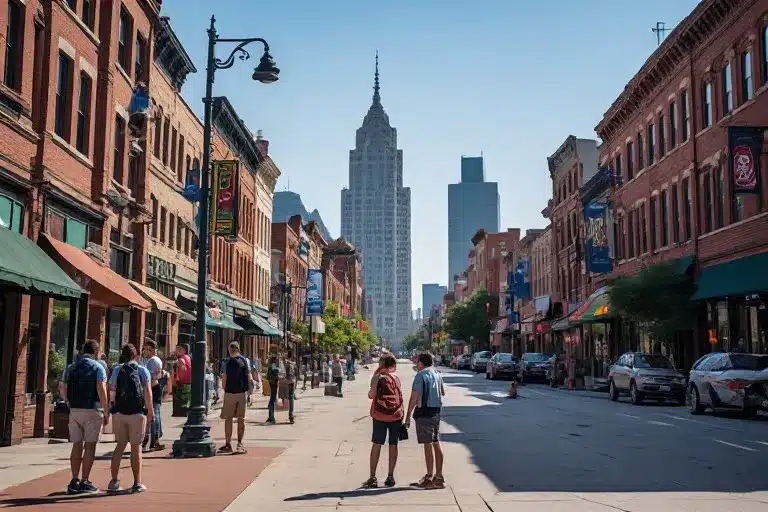
Broadway may be Nashville’s most recognizable street, but Music City extends far beyond its neon signs, honky-tonks, rooftop bars, and live music venues. Historic neighborhoods, music-industry districts, universities, cultural landmarks, parks, restaurants, and local communities provide entirely different perspectives on the city.
For visitors considering downtown Nashville tours, Broadway can be an excellent starting point rather than the entire itinerary. Exploring beyond the entertainment district reveals how Nashville developed, where its music industry operates, how different communities contributed to its identity, and where locals experience the city away from its busiest tourist corridor.
Why Explore Nashville Beyond Broadway?
Lower Broadway provides one of Nashville’s most energetic visitor experiences.
Live music pours from venues throughout the day, historic commercial buildings line the street, and major attractions are within walking distance. However, concentrating an entire Nashville trip within this relatively small area means missing much of what makes the city interesting.
Nashville Is More Than an Entertainment District
Nashville is a collection of neighborhoods and districts with different histories and personalities.
Some areas are closely connected with the recording industry. Others preserve nineteenth-century architecture, African American history, educational institutions, residential communities, restaurants, public art, and local businesses.
Moving beyond Broadway gives visitors a better sense of Nashville as a functioning city rather than simply a tourism destination.
Start With Historic Downtown Nashville
Before leaving downtown completely, explore the historic areas surrounding Broadway.
The downtown core contains government buildings, churches, former commercial properties, museums, alleys, and streets that reveal Nashville’s development long before modern tourism transformed Lower Broadway.
Look Beyond the Honky-Tonks
Historic architecture remains visible throughout downtown.
Visitors who look above modern storefronts can find older brickwork, windows, cornices, stone details, and commercial facades that reflect earlier periods of Nashville’s growth.
The buildings help demonstrate that Broadway’s entertainment identity is only the latest chapter in a much longer history.
Explore Second Avenue
Second Avenue provides a useful contrast with Broadway.
Its proximity to the Cumberland River reflects the importance of transportation and commerce in Nashville’s early development. Historic commercial buildings along the corridor preserve connections to an era when downtown activity depended heavily on merchants, warehouses, wholesalers, and river-related trade.
Discover Nashville’s Commercial Past
Understanding Second Avenue can change how visitors view downtown Nashville.
Instead of seeing the area only as a modern entertainment district, travelers can begin to recognize the commercial infrastructure that helped the city grow.
This historical context is one reason downtown Nashville tours can be valuable for first-time visitors.
Walk Through Printer’s Alley
Printer’s Alley offers another perspective on Nashville’s downtown history.
The alley became associated with printing and publishing businesses before developing a later reputation for nightlife and entertainment.
Its relatively small scale makes it easy to overlook, but its changing identity demonstrates how Nashville’s urban spaces have repeatedly adapted to new industries.
Small Streets Can Hold Major Stories
Not every historically important Nashville location is a major landmark.
Alleys, street corners, former business districts, and ordinary-looking buildings can preserve stories that are difficult to recognize without local context.
Printer’s Alley demonstrates how one location can represent several different periods of the city’s history.
Visit the Tennessee State Capitol Area
Moving north from the entertainment district brings visitors toward Tennessee’s governmental center.
The Tennessee State Capitol is one of Nashville’s most important historic buildings and provides an immediate reminder that the city is not only Music City but also Tennessee’s state capital.
The surrounding area connects visitors with Nashville’s political and civic history.
See Nashville Through a Political Lens
Government buildings, monuments, public spaces, and historic architecture reveal another side of the city.
The Capitol has witnessed major periods of Tennessee history, including the Civil War, Reconstruction, political campaigns, social change, and the continued development of state government.
Adding civic landmarks to a Nashville itinerary creates a broader understanding of the city’s importance.
Discover Music Row
Visitors interested in Nashville’s music industry should consider Music Row essential.
Unlike Broadway, which emphasizes live entertainment, Music Row became associated with the business and production side of music.
Recording studios, publishing companies, record labels, management offices, and other industry organizations helped establish the district’s international reputation.
Music Row Shows How Music City Works
Many significant Music Row locations are relatively understated.
A building may appear to be an ordinary office or former house while carrying substantial recording or songwriting history.
Without context, visitors can easily drive past historically important places without recognizing them.
This is where guided sightseeing can add significant value.
See the Residential Origins of Music Row
Parts of Music Row developed from an earlier residential environment.
As Nashville’s recording industry expanded, homes and other buildings were converted for studios, publishers, labels, and related businesses.
The result is a district where residential architecture and music-industry history frequently overlap.
Music City Was Built Through an Industry
Nashville’s music reputation depends on much more than performers.
Songwriters, session musicians, producers, engineers, publishers, managers, executives, studio owners, and other professionals contributed to the city’s development as a recording center.
Exploring Music Row helps visitors understand this larger ecosystem.
Explore 12 South
12 South offers a substantially different atmosphere from Lower Broadway.
The neighborhood is known for restaurants, shops, local businesses, murals, residential streets, and a walkable commercial corridor.
It can be a useful destination for travelers who want to experience a neighborhood outside Nashville’s downtown tourism core.
Slow Down and Explore on Foot
Unlike a fast-paced sightseeing route, 12 South works well for visitors who want time to walk, browse, eat, shop, or take photographs.
The neighborhood demonstrates why exploring beyond Broadway does not always need to involve another major attraction.
Sometimes experiencing a local commercial district provides a useful contrast with downtown.
Visit Germantown
Historic Germantown provides visitors with another perspective on Nashville.
Located north of downtown, the neighborhood is associated with nineteenth-century German immigrants and contains historic architecture alongside restaurants, residences, and newer development.
Its history demonstrates the role immigration played in Nashville’s growth.
Explore Nashville’s Immigrant History
Nashville is often presented primarily through Southern and country-music narratives.
Germantown expands that story.
Immigrant communities contributed businesses, traditions, skills, religious institutions, and cultural influences that became part of the city’s development.
Exploring the neighborhood provides another layer of local history.
Experience Jefferson Street and North Nashville
Jefferson Street is essential for visitors interested in Nashville’s African American history.
The corridor became an important center of Black business, education, religion, community life, and entertainment.
Its history is closely connected with institutions such as Fisk University, Meharry Medical College, and Tennessee State University.
Nashville’s Music History Extends Beyond Broadway
Jefferson Street once supported a thriving music and nightlife scene.
Black performers and audiences participated in blues, jazz, rhythm and blues, and other musical traditions throughout the area.
This history demonstrates that Nashville’s Music City identity developed through multiple communities and genres.
Understand the Impact of Interstate 40
Exploring North Nashville also provides an opportunity to understand how transportation development changed established communities.
The construction of Interstate 40 disrupted parts of the Jefferson Street area, affecting homes, businesses, and neighborhood connections.
Modern Nashville Was Shaped by Planning Decisions
Highways can make regional travel easier while imposing significant costs on neighborhoods located along their routes.
Learning about these changes helps visitors understand why Nashville’s modern geography looks the way it does.
It also provides important context for communities whose histories are less visible in mainstream tourism.
Visit Fisk University
Fisk University is one of Nashville’s most historically important educational institutions.
Founded after the Civil War, Fisk became a major center of African American higher education and contributed to Nashville’s intellectual, cultural, musical, and civil rights history.
Learn About the Fisk Jubilee Singers
The Fisk Jubilee Singers helped introduce African American spirituals to audiences throughout the United States and internationally.
Their history is an important reminder that Nashville’s international musical reputation began developing long before the rise of the modern country music industry.
Fisk also provides an important connection between Nashville’s educational and musical histories.
Discover Nashville’s Civil Rights History
Nashville played an important role in the American civil rights movement.
Students from local colleges and universities participated in organized nonviolent campaigns challenging racial segregation, including the Nashville sit-ins beginning in 1960.
Churches, campuses, downtown businesses, and civic spaces all became part of this history.
Follow the Geography of the Movement
Civil rights history becomes easier to understand when visitors connect the locations involved.
Students organized and trained through educational and religious institutions before demonstrating at segregated downtown businesses.
Seeing these locations as part of one urban landscape reveals how neighborhoods outside Broadway connect directly with nationally significant events downtown.
Explore East Nashville
Crossing the Cumberland River provides another opportunity to experience Nashville beyond the downtown core.
East Nashville includes residential areas, restaurants, local businesses, music-related venues, and historic architecture.
Its neighborhoods have experienced repeated periods of development and change.
Experience a Different Side of Nashville
East Nashville’s atmosphere differs from the dense visitor environment of Lower Broadway.
Exploring the area can provide a better sense of how Nashville residents experience the city outside major tourism districts.
As with any residential neighborhood, visitors should respect private property and local communities while exploring.
Understand Historic Edgefield
Historic Edgefield forms an important part of East Nashville’s development.
The area became associated with distinctive residential architecture and the growth of communities across the Cumberland River from downtown.
Surviving historic homes provide evidence of Nashville’s residential development during earlier periods.
Residential Architecture Tells a Story
Homes can reveal information about wealth, family life, construction practices, neighborhood planning, and architectural preferences.
Looking beyond public landmarks to residential architecture gives visitors another way to understand how Nashville developed.
Visit Fort Negley
Fort Negley provides an important connection with Nashville’s Civil War history.
Union forces constructed the fort after occupying Nashville in 1862, and the site became part of the defensive network surrounding the city.
Its history also includes the experiences of African American laborers involved in constructing Nashville’s wartime fortifications.
Nashville Was a Major Civil War City
Modern visitors can easily overlook Nashville’s military importance because the contemporary city looks so different from its nineteenth-century landscape.
During the Civil War, Nashville became a major Union logistical center.
Exploring Fort Negley helps connect the modern city with this earlier period.
Explore Centennial Park
Centennial Park provides a different type of Nashville experience.
The park offers open space, walking areas, cultural landmarks, and one of Nashville’s most recognizable structures: the Parthenon.
The site provides visitors with an opportunity to combine sightseeing with time away from the denser downtown environment.
See Nashville’s Parthenon
The Parthenon is a full-scale representation of the ancient Greek temple and remains one of Nashville’s most unusual landmarks.
Its presence reflects Nashville’s historical association with education and its reputation as the “Athens of the South.”
For first-time visitors, the structure provides a striking contrast with Nashville’s better-known music attractions.
Discover Vanderbilt and the West End Area
The West End area demonstrates another dimension of Nashville’s identity.
Vanderbilt University and surrounding institutions contribute to Nashville’s reputation as a center of education, research, healthcare, and professional activity.
The district also connects visitors with Centennial Park and nearby neighborhoods.
Nashville Is Also an Education and Healthcare Center
Tourism marketing naturally emphasizes music and entertainment, but Nashville’s economy and identity are considerably broader.
Universities, hospitals, research institutions, healthcare companies, and professional organizations play major roles in the modern city.
Exploring beyond Broadway makes these dimensions more visible.
Explore the Gulch
The Gulch represents Nashville’s more recent urban transformation.
Today, visitors encounter hotels, restaurants, shops, residences, offices, and modern development.
Historically, however, the area’s identity was closely connected with railroads and industrial activity.
Compare Historic and Modern Nashville
The Gulch demonstrates how completely an urban district can change.
Transportation patterns, property development, tourism, population growth, and investment can transform the function and appearance of a neighborhood.
Seeing this transformation can help visitors understand the pace of change occurring throughout Nashville.
Look for Nashville’s Murals and Public Art
Public art has become a recognizable feature of several Nashville neighborhoods.
Murals provide popular photography opportunities, but they can also encourage visitors to explore areas beyond traditional attractions.
Do More Than Take the Photograph
When visiting a mural, spend time exploring the surrounding neighborhood.
Visit local businesses, learn about the area’s history, and consider how the artwork relates to its location.
This creates a more meaningful experience than treating neighborhoods solely as photography backdrops.
Try Local Restaurants Outside Broadway
Exploring beyond Broadway also opens significantly more dining possibilities.
Neighborhood restaurants, cafes, bakeries, and locally owned businesses can provide visitors with experiences that differ from the busiest downtown establishments.
Make Food Part of Neighborhood Exploration
Instead of choosing restaurants independently from sightseeing, combine the two.
Plan lunch or coffee in a neighborhood you want to explore.
This reduces unnecessary travel while giving you additional time to experience the area.
Use a Guided Tour to Understand the City’s Layout
First-time visitors may find Nashville’s attractions surprisingly spread out.
Downtown can be explored extensively on foot, but Music Row, 12 South, North Nashville, East Nashville, Centennial Park, and other districts require more transportation planning.
This is where guided vehicle-based sightseeing can be particularly useful.
Start Broad and Explore Later
A useful strategy is to take a broader city tour early in your visit.
Use the experience to understand Nashville’s geography and identify neighborhoods that interest you.
Then return independently to selected areas later in the trip.
This approach combines efficient orientation with flexible exploration.
Combine Downtown Nashville Tours With Neighborhood Exploration
Downtown Nashville tours and neighborhood exploration do not need to compete for itinerary space.
They serve different purposes.
Downtown provides concentrated access to entertainment, historic streets, civic landmarks, museums, and architecture. Neighborhood exploration reveals how the larger city developed and functions.
Build a Balanced Nashville Itinerary
A balanced itinerary might include:
- Lower Broadway
- Historic downtown streets
- Printer’s Alley
- Tennessee State Capitol
- Music Row
- 12 South
- Jefferson Street
- Fisk University
- Centennial Park
- East Nashville
- Germantown
- Local restaurants and businesses
The exact combination should depend on your interests, available time, transportation, and travel style.
Frequently Asked Questions
Is there more to Nashville than Broadway?
Yes. Nashville includes historic neighborhoods, universities, music-industry districts, museums, parks, cultural landmarks, restaurants, African American historic sites, and residential communities beyond Broadway.
What neighborhoods should first-time Nashville visitors explore?
Popular areas to consider include 12 South, Germantown, East Nashville, Music Row, and areas of North Nashville. The best choices depend on whether your interests include history, music, food, shopping, architecture, or local culture.
Is Music Row close to Broadway?
Music Row is outside the Lower Broadway entertainment district. Transportation may be more convenient than walking for some visitors, particularly when combining Music Row with several other neighborhoods.
What historical sites can I see beyond Broadway?
Visitors can explore places connected with the Tennessee State Capitol, Fisk University, Fort Negley, Nashville’s civil rights history, historic neighborhoods, universities, and other cultural and civic landmarks.
Are downtown Nashville tours worth taking?
For first-time visitors, a guided downtown experience can provide historical context and help explain landmarks that may otherwise appear unrelated. A broader city tour can also help visitors understand areas beyond downtown.
How many days do I need to explore Nashville beyond Broadway?
Two or more days provide greater flexibility, although visitors with limited time can still combine downtown sightseeing with one or two neighborhoods. Prioritize areas according to your strongest interests.
Broadway deserves its place on a Nashville itinerary, but it should not define the entire visit. Music City’s history, music industry, African American heritage, universities, neighborhoods, architecture, parks, food, and local culture extend throughout the surrounding city.
Combining downtown Nashville tours with exploration of Music Row, Jefferson Street, Germantown, 12 South, East Nashville, Centennial Park, and other districts provides a more complete understanding of Nashville. Broadway introduces the city’s famous entertainment scene; exploring beyond it reveals the many communities and stories that made Nashville what it is today.