
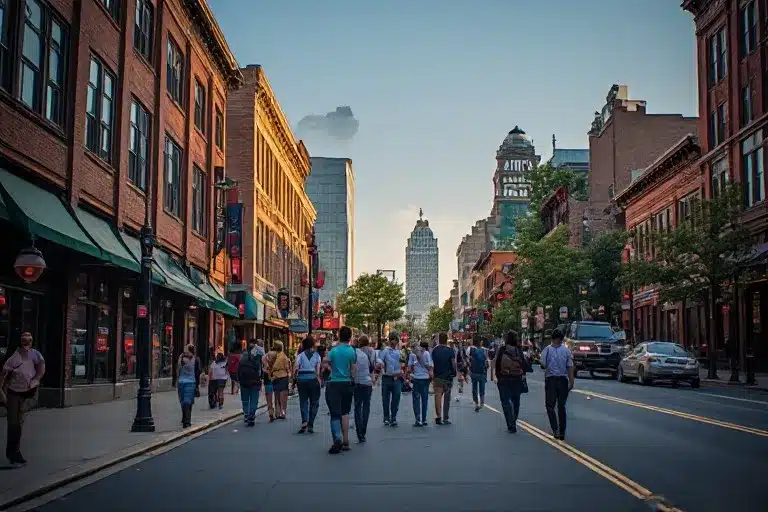
Downtown Nashville is compact enough to explore on foot, yet dense with historic buildings, music landmarks, public spaces, architectural details, and stories that are easy to miss from a vehicle. Walking allows visitors to slow down, examine individual places, and understand how Nashville’s streets connect.
A downtown Nashville walking tour can turn an ordinary walk through Music City into a more detailed sightseeing experience. Instead of simply moving between major attractions, visitors can discover historic streets, hidden architectural features, music landmarks, civil rights sites, riverfront history, and the stories behind familiar downtown locations.
Why Is Walking One of the Best Ways to Explore Downtown Nashville?
Walking changes the scale at which visitors experience a city.
From a vehicle, Nashville’s buildings, streets, and landmarks can pass quickly. On foot, visitors have time to notice inscriptions, historic markers, architectural details, alleys, storefronts, public art, and connections between nearby locations.
Downtown Nashville Has a Concentrated Historic Core
Many significant downtown locations are relatively close together.
Broadway, Second Avenue, Printer’s Alley, the Cumberland River, the Ryman Auditorium, historic churches, civic buildings, and other landmarks can be connected through pedestrian sightseeing.
This concentration makes walking particularly useful for visitors interested in history and architecture.
Walking Helps You Understand Nashville’s Geography
Maps show where attractions are located, but walking helps visitors understand how those places relate physically.
You can see how Broadway approaches the Cumberland River, how historic commercial streets connect with civic areas, and how Nashville’s modern entertainment district overlaps with its older downtown core.
The Cumberland River Explains Much of Downtown Nashville
Nashville developed along the Cumberland River.
The river supported transportation, trade, and commercial growth long before highways and modern tourism shaped the city.
Walking between the riverfront and historic downtown streets helps visitors visualize why businesses and transportation networks developed where they did.
Experience Lower Broadway at Street Level
Lower Broadway is one of Nashville’s most recognizable visitor destinations.
Honky-tonks, live music, restaurants, historic commercial buildings, rooftop venues, and neon signs create an energetic streetscape.
Walking allows visitors to experience this environment directly rather than viewing it through a vehicle window.
Look Above the Modern Storefronts
One of the easiest ways to find historic Nashville on Broadway is to look upward.
Modern businesses occupy many ground-floor spaces, but upper stories may retain older brickwork, windows, cornices, decorative details, and architectural features.
These details provide evidence of Broadway’s earlier commercial history.
Broadway Was a Commercial Street Before It Became an Entertainment District
Today’s Broadway is strongly associated with tourism and live music.
Historically, however, the area served commercial purposes connected with Nashville’s downtown economy and proximity to the Cumberland River.
Understanding this earlier identity adds depth to the modern entertainment experience.
Walking Reveals Layers of History
A building can contain several historical layers.
Its original purpose may have been commercial. Later occupants may have changed the interior or storefront. Eventually, the building may have become a restaurant, bar, shop, or music venue.
Walking gives visitors time to examine these transitions more closely.
Explore Second Avenue on Foot
Second Avenue provides another important perspective on Nashville’s commercial history.
Historic buildings along the corridor reflect the city’s relationship with river trade, merchants, warehouses, wholesalers, and downtown business activity.
Its proximity to Broadway makes it easy to incorporate into a walking route.
Historic Streetscapes Are Easier to Read While Walking
Individual buildings become more meaningful when viewed alongside neighboring structures.
Visitors can compare building heights, materials, windows, entrances, and architectural details.
This helps reveal how groups of historic commercial properties once functioned together.
Discover Printer’s Alley
Printer’s Alley is one of Downtown Nashville’s most distinctive smaller streets.
Its history is associated with the printing and publishing businesses that once operated nearby, followed by later connections with nightlife and entertainment.
Walking is particularly well suited to exploring a location of this scale.
Alleys Can Hold Important History
Major boulevards naturally receive attention, but smaller urban spaces can preserve equally interesting stories.
Alleys historically supported deliveries, service access, businesses, utilities, and other functions essential to downtown commerce.
Printer’s Alley demonstrates how one small location can develop several identities over time.
Walk to the Ryman Auditorium
The Ryman Auditorium is one of Nashville’s most important music landmarks.
Originally constructed as the Union Gospel Tabernacle, the building later became a celebrated performance venue and longtime home of the Grand Ole Opry.
Its location makes it easy to connect with other downtown music and history sites on foot.
The Ryman Shows How Buildings Change Purpose
Historic buildings do not always retain their original function.
The Ryman’s transformation from a religious gathering space into an internationally recognized music venue demonstrates how Nashville buildings can acquire new cultural significance over generations.
Seeing the structure within its downtown setting helps place that transformation in context.
Explore Nashville’s Historic Churches
Downtown Nashville contains several historic churches that provide insight into architecture, religious history, community development, and social change.
Walking between them allows visitors to compare different architectural styles and periods.
Downtown Presbyterian Church
Downtown Presbyterian Church is particularly notable for its Egyptian Revival architecture.
Designed by William Strickland, who also designed the Tennessee State Capitol, the building stands out from architectural styles commonly associated with historic American churches.
Its details are much easier to appreciate from street level.
Walk Toward the Tennessee State Capitol
A walking route extending beyond the entertainment district can introduce visitors to Nashville’s political and civic history.
The Tennessee State Capitol is one of the city’s most important historic buildings and provides a strong visual landmark above portions of downtown.
Nashville Is More Than Music City
Nashville is Tennessee’s state capital as well as an international music destination.
Exploring civic areas introduces visitors to political history, government, architecture, and public spaces that are often overshadowed by Broadway.
This broader perspective helps create a more complete understanding of the city.
Explore Bicentennial Capitol Mall State Park
Visitors willing to extend their downtown walk can explore Bicentennial Capitol Mall State Park.
The park incorporates Tennessee history, geography, monuments, and interpretive features into its landscape.
It can be paired naturally with the State Capitol area.
Walking Turns the Landscape Into an Exhibit
Unlike a traditional museum, Bicentennial Capitol Mall presents much of its information through the landscape.
Visitors move physically between features while learning about Tennessee.
This format makes walking an integral part of the historical experience.
Follow Nashville’s Civil Rights History
Downtown Nashville was an important setting during the civil rights movement.
Beginning in 1960, students participated in organized nonviolent sit-ins challenging segregation at downtown lunch counters.
Walking through the areas associated with these events helps visitors understand the physical geography of the movement.
Ordinary Streets Became Historic Places
Civil rights history did not occur only inside government buildings or designated monuments.
Restaurants, stores, sidewalks, churches, and streets became important because of the actions that took place there.
A downtown Nashville walking tour can connect these ordinary urban spaces with nationally significant events.
Understand the Nashville Sit-Ins
The Nashville sit-ins were carefully organized demonstrations against racial segregation.
Students prepared through nonviolent training before entering segregated downtown businesses and requesting service.
Their actions became part of a broader campaign that challenged discriminatory practices.
Walking Helps Connect Preparation With Protest
Civil rights activity extended beyond the specific businesses where demonstrations occurred.
Churches, educational institutions, community organizations, and downtown locations formed a larger network.
Understanding the distance and relationship between these places can make the movement easier to visualize.
See Nashville City Hall and Public Square
The Public Square area provides another important stop for visitors interested in civic history.
Public spaces have historically served as places for government, commerce, gatherings, demonstrations, and community activity.
Public Space Can Become Political Space
One of Nashville’s important civil rights moments involved a march to City Hall following the bombing of attorney Z. Alexander Looby’s home in 1960.
Student activists confronted Mayor Ben West over segregation.
Understanding where these events occurred gives visitors a stronger connection with Nashville’s civil rights history.
Walking Makes Architecture Easier to Appreciate
Architecture is one of the strongest reasons to explore Nashville on foot.
From a vehicle, visitors may recognize entire buildings but miss smaller details.
Walking provides time to examine materials, construction styles, windows, doors, cornices, stonework, inscriptions, and decorative features.
Look Up While You Walk
Many downtown storefronts have been heavily modified.
Upper floors can preserve significantly more historical character.
When conditions are safe, look above street level for:
- Original windows
- Brick patterns
- Decorative cornices
- Stone details
- Historic dates
- Architectural ornaments
- Older signage
- Changes in building materials
These details can reveal how Nashville developed over different periods.
Walking Helps You Discover Hidden Details
Some of the most memorable parts of a city are not major attractions.
Historic markers, small monuments, unusual architectural details, plaques, alleyways, murals, old signs, and unexpected views can become highlights of a walking route.
Slow Sightseeing Creates More Opportunities
Vehicle sightseeing is efficient for covering large distances.
Walking provides the opposite advantage.
Visitors can stop when something catches their attention, examine a building more closely, read a historical marker, or change direction toward an interesting street.
This flexibility makes walking particularly effective in dense historic areas.
Downtown Nashville Is Ideal for Photography
Walking gives photographers more control over viewpoints and timing.
Instead of photographing through a window, visitors can adjust their position, explore side streets, and wait for better compositions.
Photograph More Than Broadway’s Neon Signs
Popular Nashville photographs often focus on honky-tonks and neon.
Consider photographing:
- Historic facades
- The Cumberland River
- Architectural details
- Alleys
- Churches
- Public art
- Civic buildings
- Street signs
- Older commercial structures
- Contrasts between historic and modern buildings
These images can provide a more complete visual record of Downtown Nashville.
Walking Connects Music History With the Modern City
Nashville’s music history is embedded throughout downtown.
The Ryman Auditorium, Lower Broadway, historic performance spaces, museums, and entertainment venues represent different periods of the city’s musical development.
Walking allows visitors to move directly between these layers.
Music History Is Not Confined to Museums
Museums provide valuable collections and interpretation, but Nashville’s streets are part of the story.
Buildings, venues, commercial districts, and public spaces show how music became integrated into the city’s physical and economic development.
Exploring them on foot adds geographic context to what visitors learn indoors.
Walking Lets You Experience Live Music Naturally
Lower Broadway and surrounding entertainment areas contain numerous live music venues.
Walking allows visitors to hear how the atmosphere changes from one location to another.
Music becomes part of the streetscape rather than a single scheduled attraction.
Nashville’s Soundscape Is Part of the Experience
Cities are experienced through sound as well as sight.
Live performances, crowds, traffic, street activity, and the riverfront environment all contribute to Downtown Nashville’s character.
Walking places visitors directly within that environment.
Explore the Cumberland Riverfront
The riverfront is easy to overlook when Broadway commands so much attention.
Yet the Cumberland River is fundamental to understanding why Nashville developed where it did.
Walking toward the river provides useful geographic context.
Imagine Nashville Before Modern Transportation
Before interstate highways, airports, and automobiles, waterways were essential transportation corridors.
The Cumberland connected Nashville with regional trade networks.
Standing near the river allows visitors to imagine a downtown shaped by boats, warehouses, merchants, and goods moving through the city.
Walking Supports Local Businesses
Exploring on foot naturally exposes visitors to businesses they might otherwise pass.
Coffee shops, restaurants, stores, museums, entertainment venues, and other establishments become easier to discover when visitors move slowly through the district.
Leave Room for Unplanned Stops
An overly rigid itinerary can make walking feel like a race between attractions.
Allow time to enter an interesting shop, stop for food, read a historical marker, or explore a side street.
Some of the strongest travel experiences come from these unscheduled discoveries.
Walking Can Save Time in Dense Areas
Driving short distances downtown can involve traffic, one-way streets, parking, and repeated vehicle entry and exit.
Once visitors are already in the downtown core, walking between nearby attractions may be more practical.
Use Transportation Strategically
Walking does not need to replace every other form of transportation.
Use vehicles for destinations farther from downtown, such as Music Row, Centennial Park, or other neighborhoods when appropriate.
Then explore concentrated areas on foot.
Combining transportation methods often produces the most efficient itinerary.
Morning Walking Tours Offer a Different Atmosphere
Downtown Nashville changes significantly throughout the day.
Morning walks can provide cooler temperatures during warmer months and potentially less intense entertainment activity than later periods.
This can make architectural and historical sightseeing easier.
Morning Can Be Better for Detailed Sightseeing
Visitors primarily interested in photography, architecture, and history may appreciate walking before the entertainment district becomes busier.
However, conditions vary by season, weekday, events, and tourism patterns.
Check the day’s schedule before planning your route.
Evening Walks Show Nashville’s Entertainment Identity
As evening approaches, Lower Broadway becomes increasingly associated with live music, illuminated signs, nightlife, and crowds.
Visitors seeking Nashville’s entertainment atmosphere may prefer exploring during this period.
Choose the Time Based on Your Priorities
There is no universally best time for a downtown walk.
Morning may suit history and architecture.
Afternoon can work well for museums and attractions.
Evening highlights live music and nightlife.
Your ideal schedule depends on what you want to experience.
Prepare for Nashville Weather
Walking means greater exposure to weather.
Nashville summers can be hot and humid, while rain, storms, colder temperatures, and seasonal changes can affect outdoor sightseeing.
Check current conditions before beginning a longer route.
Dress for Walking, Not Just Photographs
Comfortable footwear is one of the most important considerations.
Also consider:
- Water
- Sun protection
- Weather-appropriate clothing
- Rain protection when needed
- A charged phone
- Any required medications
- A manageable bag
Comfort makes it easier to focus on the city rather than physical discomfort.
Consider Downtown Terrain and Accessibility
Downtown Nashville is walkable, but visitors should not assume every route is completely flat or equally accessible.
Hills, street crossings, construction, crowds, older infrastructure, and temporary closures can affect routes.
Adjust the Route to Your Group
Families, seniors, visitors with mobility limitations, and travelers with young children may require shorter routes or more frequent stops.
Choose a route based on the needs of the group rather than attempting to cover every attraction.
Quality matters more than distance.
Stay Aware in Busy Pedestrian Areas
Downtown Nashville can become extremely busy, particularly around Broadway, major events, weekends, and evening entertainment periods.
Pedestrians should remain attentive at intersections and avoid becoming distracted by phones while crossing streets.
Use Designated Crossings
Follow traffic signals and use designated pedestrian crossings whenever possible.
Crowds can make it tempting to follow other pedestrians into the street, but individual attention remains important.
A safe walking experience requires awareness of traffic and surrounding conditions.
A Guided Walk Adds Historical Context
Visitors can certainly explore Downtown Nashville independently.
However, a guided experience can explain details that are not obvious from the street.
A building may appear ordinary until someone explains what happened there, who occupied it, or how its function changed.
Stories Connect Individual Landmarks
Without context, visitors may experience downtown as a sequence of unrelated attractions.
A guide can connect the Cumberland River, Broadway, historic businesses, music venues, churches, government buildings, and civil rights sites into a broader narrative.
That connection is one of the primary advantages of a downtown Nashville walking tour.
What to Look for During a Downtown Nashville Walking Tour
A productive walking experience involves more than checking landmarks off a list.
Pay attention to how the city fits together.
Observe the Details
Look for:
- Historic architecture
- Building dates
- Old commercial facades
- Street-name changes
- Historic markers
- Music landmarks
- Civil rights locations
- Public art
- Alleys
- River views
- Government buildings
- Churches
- Contrasts between old and new Nashville
These observations can reveal details that visitors moving quickly through downtown often miss.
Frequently Asked Questions
Is Downtown Nashville easy to explore on foot?
Many major downtown attractions are concentrated within a relatively compact area, making walking practical for many visitors. Hills, weather, crowds, construction, and individual mobility should still be considered.
What can I see on a downtown Nashville walking tour?
Depending on the route, visitors may encounter Broadway, Second Avenue, Printer’s Alley, the Ryman Auditorium, historic churches, civic landmarks, the Cumberland Riverfront, architecture, and civil rights sites.
How long should I spend walking Downtown Nashville?
The appropriate amount of time depends on the route and number of stops. A shorter walk can cover major landmarks, while visitors interested in history, architecture, museums, and photography may want several hours.
What should I wear for a Nashville walking tour?
Wear comfortable walking shoes and clothing appropriate for current weather. During warmer conditions, water and sun protection are particularly important.
Is it better to walk Downtown Nashville in the morning or evening?
Morning can be useful for history, architecture, and potentially quieter sightseeing. Evening provides more of Nashville’s live music and nightlife atmosphere. The best choice depends on your priorities.
Is a guided Downtown Nashville walking tour worth it?
A guided tour can add value by connecting buildings, streets, landmarks, and historical events that may not be obvious during independent sightseeing.
Walking allows Downtown Nashville to be experienced at street level, where many of its most interesting details become visible. Historic facades, music venues, alleys, churches, civil rights sites, public spaces, and the Cumberland River all become easier to connect when visitors move through the city at a slower pace.
A downtown Nashville walking tour combines that close-up experience with historical context, helping visitors understand not only what they are seeing but why each location matters. For travelers who want to experience the architecture, history, music, and street-level character of Music City, exploring downtown on foot remains one of the most effective ways to do it.